

In recent years, the Netherlands has found itself navigating a challenging political landscape. Electoral fragmentation, declining voter loyalty, and the growing influence of radical right narratives have made the formation of stable majority governments increasingly difficult. In this environment, political inaction has carried its own risks—chief among them the normalization of exclusionary discourse and the erosion of trust in democratic institutions.
Against this backdrop, the minority government led by Rob Jetten should be understood not as a reluctant compromise, but as a conscious act of democratic responsibility. The decision by D66, VVD, and CDA to govern together sends a clear message: when radical right forces threaten to dominate the political narrative, mainstream parties can still unite around shared democratic values.

Choosing Cooperation Over Political Vacuum
For several consecutive years, the Netherlands has struggled to produce durable governing coalitions. This has not been due to democratic weakness, but rather to democratic pluralism taken to its extreme. Parliament increasingly reflects a society with diverse, and sometimes conflicting, priorities. In such a setting, insisting on mathematically comfortable majorities has often resulted in prolonged stalemate.
Political vacuums, however, are rarely neutral. Across Europe, radical right movements have proven adept at exploiting moments of institutional paralysis, presenting themselves as the only actors capable of “decisive action.” The Dutch minority government can therefore be read as a pre-emptive response to this dynamic: an effort to ensure continuity, stability, and democratic presence at the center of power.
Ministerial Distribution as a Deliberate Balance
The allocation of ministerial portfolios within the cabinet reflects this broader logic of shared responsibility. Rather than concentrating power in one ideological direction, the distribution creates a balance between reform, stability, and institutional continuity.
D66: Investing in Democratic Resilience
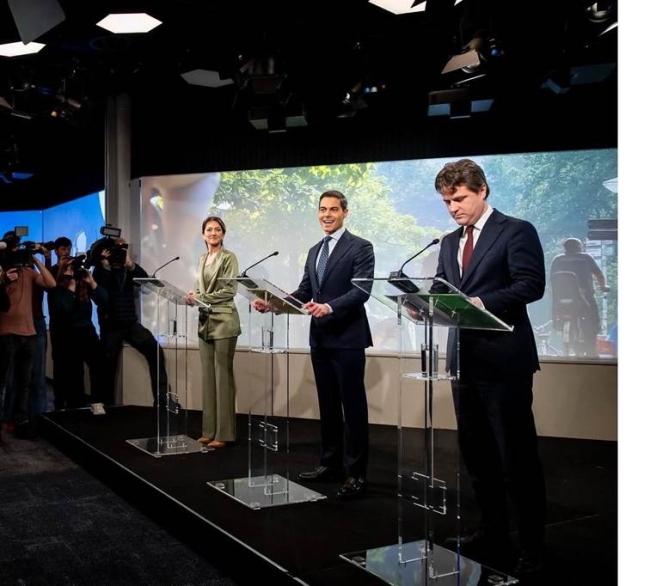
As the party of the Prime Minister, D66 has taken on ministries that directly shape the long-term social and democratic fabric of the country. These include Education, Culture and Science; Housing and Spatial Planning; Climate and Green Growth; Social Affairs and Employment; and Foreign Trade and Development Cooperation.
These portfolios are not chosen for short-term political gain. Education, housing, climate policy, and labor market inclusion are precisely the areas where democratic resilience is built over time. By assuming responsibility for these sectors, D66 signals a commitment to addressing the structural grievances that radical right movements often exploit—such as inequality, housing insecurity, and social exclusion.
At the state secretary level, D66’s involvement in Finance, Justice and Security, and the digital economy further underlines its willingness to engage across policy domains, even within the constraints of minority governance.
VVD: Stability, Security, and Administrative Continuity
VVD’s ministerial responsibilities focus on maintaining institutional reliability and public confidence in the state. By holding Finance, Justice and Security, Defence, Infrastructure and Water Management, and Health, Welfare and Sport, VVD ensures that core state functions continue to operate smoothly.
In the current political climate, this role is crucial. Fiscal discipline, public safety, and effective healthcare provision are often areas where radical right rhetoric seeks to amplify fear or dissatisfaction. VVD’s presence in these ministries helps neutralize such narratives by emphasizing competence, continuity, and rule-based governance rather than ideological polarization.
Through additional state secretary roles in interior affairs, education, and agriculture, VVD contributes to cross-sectoral coordination, reinforcing the cabinet’s image as a responsible governing body rather than an ideologically driven alliance.
CDA: Anchoring Institutions and Social Trust
CDA’s portfolio selection reflects its traditional role as a guardian of institutional stability and social cohesion. With responsibility for Foreign Affairs, Interior and Kingdom Relations, Economic Affairs and Climate, and Long-Term Care, Youth and Sport, CDA operates at the intersection of governance, diplomacy, and social solidarity.
In times of political uncertainty, these domains play a stabilizing role. Foreign policy continuity reassures international partners; interior governance safeguards constitutional norms; and long-term care policies reinforce intergenerational trust. CDA’s participation thus strengthens the cabinet’s institutional credibility, an essential counterweight to radical narratives that question the legitimacy of democratic governance itself.
A United Democratic Front
Taken together, this ministerial distribution illustrates a broader strategic choice. Rather than competing for ideological dominance, the governing parties have opted for complementarity. Each party contributes according to its strengths, creating a cabinet that reflects diversity without fragmentation.
This unity is particularly significant in the context of rising radical right influence. By cooperating across ideological lines, D66, VVD, and CDA demonstrate that democratic politics can still deliver governance without resorting to exclusionary or polarizing rhetoric. The minority government thus functions not only as an administrative arrangement, but as a symbolic reaffirmation of the democratic center.
Minority Governance as Democratic Maturity
Minority governments are often perceived as inherently weak. Yet in highly pluralistic societies, they can also be a sign of democratic maturity. Governing without an automatic parliamentary majority requires constant dialogue, transparency, and respect for opposition voices. Policies must be justified, negotiated, and adapted—reducing the temptation to impose simplistic solutions to complex problems.
In this sense, the Dutch minority government embodies a form of “deliberative governance.” It does not seek to silence dissent, but to integrate it into decision-making processes. This approach directly counters the radical right’s appeal to absolute certainty and unilateral action.
A Constructive Response to a European Challenge
The Dutch experience is not isolated. Across Europe, democracies are grappling with similar tensions between fragmentation and governability, openness and polarization. By choosing cooperation over paralysis, the Netherlands offers a modest but meaningful example of how democratic systems can adapt without surrendering their core values.
This minority government will face challenges, compromises, and limitations. Yet its very existence affirms an essential principle: when democratic norms are under pressure, responsible actors can still come together to defend them.
In uniting against the pull of radical right politics, the Dutch governing parties have chosen continuity over chaos, dialogue over division, and responsibility over retreat. In today’s Europe, that choice matters more than ever.